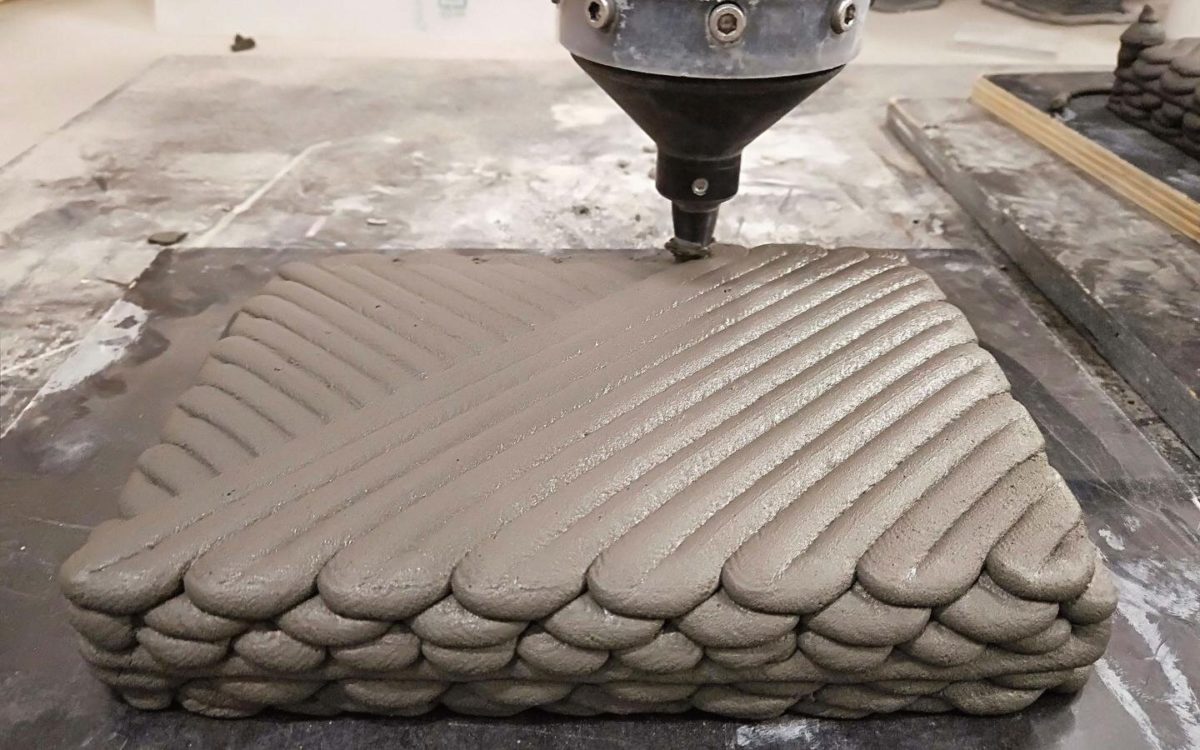
3D printing gets bigger, faster and stronger
Written by: Mark Zastrow
Publish Date: February 07, 2020
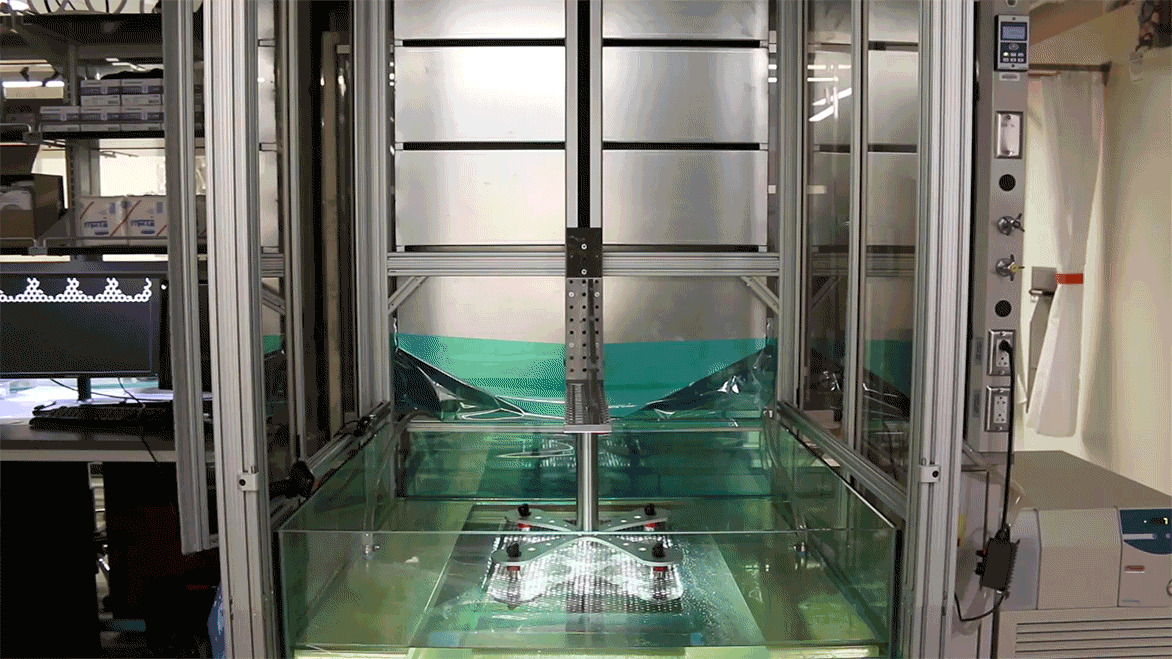
As a metal platform rises from a vat of liquid resin, it pulls an intricate white shape from the liquid — like a waxy creature emerging from a lagoon. This machine is the world’s fastest resin-based 3D printer and it can create a plastic structure as large as a person in a few hours, says Chad Mirkin, a chemist at Northwestern University in Evanston, Illinois. The machine, which Mirkin and his colleagues reported last October1, is one of a slew of research advances in 3D printing that are broadening the prospects of a technology once viewed as useful mainly for making small, low-quality prototype parts. Not only is 3D printing becoming faster and producing larger products, but scientists are coming up with innovative ways to print and are creating stronger materials, sometimes mixing multiple materials in the same product.
Sportswear firms, aviation and aerospace manufacturers and medical-device companies are eager to take advantage. “You’re not going to be sitting in your home, printing out exactly what you want to repair your car any time soon, but major manufacturing companies are really adopting this technology,” says Jennifer Lewis, a materials scientist at Harvard University in Cambridge, Massachusetts.
The latest techniques could be lucrative for researchers, many of whom — Lewis and Mirkin among them — are already commercializing their work. They’re also fundamentally exciting, says Iain Todd, a metallurgist at the University of Sheffield, UK. “We can get performance out of these materials that we didn’t think we could get. That’s what’s really exciting to a materials scientist. This is getting people used to the new weird.”
From trinkets to products
The 3D printing technique is also referred to as ‘additive manufacturing’, because instead of chopping or milling a shape out of a larger block, or casting molten material in a mould, it involves building objects from the bottom up. Its advantages include less waste and an ability to print custom designs, such as intricate lattice structures, that are otherwise hard to create. Low-cost hobbyist machines print by squeezing out thin plastic filaments from heated nozzles, building up a structure layer by layer — a method known as fused deposition modelling (FDM). But the term 3D printing encompasses a much wider range of techniques. One of the oldest uses an ultraviolet laser to scan across and solidify (or ‘cure’) light-sensitive resin, layer by layer. That concept was described as far back as 1984, in a patent filed by Charles Hull2, the founder of a company called 3D Systems in Rock Hill, South Carolina.
The latest techniques — including Mirkin’s — still use light-sensitive resin, but are faster and larger-scale, following improvements reported in 2015 by a team led by Joseph DeSimone, a chemist and materials scientist at the University of North Carolina at Chapel Hill3. Early printers were slow, small-scale and prone to producing layered, imperfect and weak structures. These found a niche in rapid prototyping, making plastic model parts as mock-ups for later production by conventional methods. As an area of research, this kind of printing wasn’t thrilling, says Timothy Scott, a polymer scientist at Monash University in Melbourne, Australia: “Basically making trinkets and knick-knacks. For a polymer chemist, it was pretty dull.”
About the Author
This article is written by Mark Zastrow
Read the original post here.